FB15K: Loading FB15K-237 into Neo4j
A practical Cypher import—and what a graph of MIDs and 237 relation names reveals about knowledge graph benchmark data.
In the previous article, I explained what FB15K and FB15K-237 are, why inverse relations matter, and what the benchmark is designed to measure.
This time, I look at the actual files.
I download FB15K-237, load its knowledge-base triples into Neo4j, and explore the resulting graph with Cypher.
The import itself is simple because the source data is already expressed as triples. The more interesting result appears after the import: the graph has rich structure, but almost no human-readable context.
What we will build
For this first exploration, each Freebase MID becomes an Entity node, and each source triple becomes a RELATION relationship.
(:Entity {mid})-[:RELATION {name, split}]->(:Entity {mid})The relationship stores:
name: the original Freebase relationsplit:train,valid, ortest
This keeps the source values unchanged and preserves the benchmark boundary inside Neo4j.
Downloading FB15K-237
I used the package published by Microsoft:
The downloaded archive has a name similar to:
FB15K-237.2.zipAfter extraction, it contains files such as:
README.txt
train.txt
valid.txt
test.txt
text_cvsc.txt
text_emnlp.txt
For this Neo4j import, I use only the knowledge-base triples:
train.txt
valid.txt
test.txt
The two text_*.txt files contain textual dependency paths derived from ClueWeb12. They are useful for research combining text and knowledge bases, but they are not required for this graph import.
Inspecting the triple format
Each line contains three tab-separated values:
/m/0grwj /people/person/profession /m/05sxg2The format is:
subject MID relation object MIDIt maps directly to a property graph:
(Entity)-[Relation]->(Entity)The two MIDs become nodes, and the Freebase relation becomes a relationship between them.
Choosing a Neo4j model
There are at least two reasonable ways to represent the 237 Freebase relation names.
Option 1: one Neo4j relationship type per relation
(:Entity)-[:PEOPLE_PERSON_PROFESSION]->(:Entity)This makes each relation visible as a Neo4j relationship type, but it requires transforming the original path-like names into valid type names.
Option 2: one relationship type with properties
(:Entity)-[:RELATION {
  name: "/people/person/profession",
  split: "train"
}]->(:Entity)
For this article, I use the second model.
It has several advantages for an introductory import:
- the original relation string is preserved
- all files can use the same Cypher pattern
- the model is easy to query and explain
- it works without generating 237 relationship types
The trade-off is that queries filter on r.name instead of using a specific Neo4j relationship type.
Japanese note:
237種類の関係をNeo4jのリレーションタイプに変換する方法もあります。ここでは元のFreebase関係名を変えずに保持し、ロード処理を分かりやすくするため、:RELATIONのnameプロパティに保存します。
Preparing the import directory
Place the three files under the Neo4j import directory.
import/
└── fb15k-237/
    ├── train.txt
    ├── valid.txt
    └── test.txt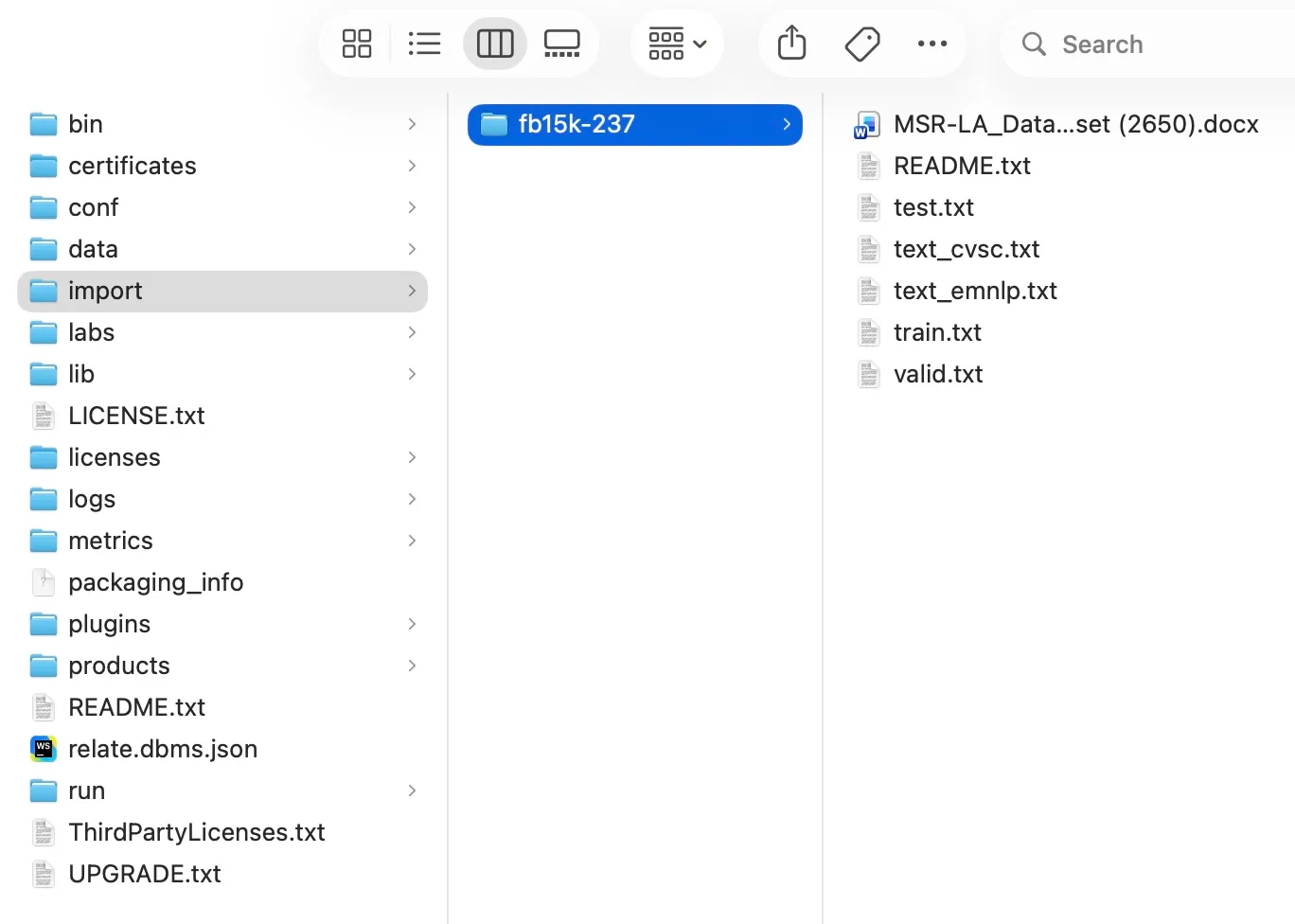
The exact path depends on the installation.
- Neo4j Desktop: open the database folder and use its
importdirectory. - Docker: mount a local directory to
/var/lib/neo4j/import.
Creating a uniqueness constraint
Before importing the triples, create a uniqueness constraint for the MID property.
CREATE CONSTRAINT entity_mid_unique IF NOT EXISTS
FOR (e:Entity)
REQUIRE e.mid IS UNIQUE;
This allows MERGE to find an existing entity instead of creating the same MID more than once.
Loading the training data
The files do not contain a header row, so the fields are accessed by position.
LOAD CSV FROM 'file:///fb15k-237/train.txt' AS row
FIELDTERMINATOR '\u0009'
CALL (row) {
  MERGE (subject:Entity {mid: row[0]})
  MERGE (object:Entity {mid: row[2]})
  CREATE (subject)-[:RELATION {
    name: row[1],
    split: 'train'
  }]->(object)
} IN TRANSACTIONS OF 10000 ROWS;
The query uses MERGE for nodes and CREATE for relationships.
This is intentional:
- an entity with the same MID should be reused
- every source row should become one relationship
Using MERGE for the complete relationship pattern could collapse duplicate rows. For a benchmark dataset, preserving the source records is usually clearer.
Loading validation and test data
The validation file uses the same structure:
LOAD CSV FROM 'file:///fb15k-237/valid.txt' AS row
FIELDTERMINATOR '\u0009'
CALL (row) {
  MERGE (subject:Entity {mid: row[0]})
  MERGE (object:Entity {mid: row[2]})
  CREATE (subject)-[:RELATION {
    name: row[1],
    split: 'valid'
  }]->(object)
} IN TRANSACTIONS OF 10000 ROWS;
The test file is imported in the same way:
LOAD CSV FROM 'file:///fb15k-237/test.txt' AS row
FIELDTERMINATOR '\u0009'
CALL (row) {
  MERGE (subject:Entity {mid: row[0]})
  MERGE (object:Entity {mid: row[2]})
  CREATE (subject)-[:RELATION {
    name: row[1],
    split: 'test'
  }]->(object)
} IN TRANSACTIONS OF 10000 ROWS;
The examples use CALL { ... } IN TRANSACTIONS so the import does not depend on one large transaction. The batch size can be adjusted for the available memory and Neo4j configuration.
Verifying the import
Count the entities:
MATCH (e:Entity)
RETURN count(e) AS entities;
Count all imported triples:
MATCH ()-[r:RELATION]->()
RETURN count(r) AS triples;
Count the distinct Freebase relation names:
MATCH ()-[r:RELATION]->()
RETURN count(DISTINCT r.name) AS relations;
The commonly published FB15K-237 statistics are:
| Item | Count |
|---|---|
| Entities | 14,541 |
| Relation names | 237 |
| Training triples | 272,115 |
| Validation triples | 17,535 |
| Test triples | 20,466 |
| Total triples | 310,116 |
These are the counts reported for the official FB15K-237 release. If the imported counts differ, check whether the files were modified or whether rows were skipped or duplicated during import.
Checking the benchmark splits
Because each relationship stores its source split, the counts can be checked directly:
MATCH ()-[r:RELATION]->()
RETURN r.split AS split, count(*) AS triples
ORDER BY split;
This should return one row for train, valid, and test.
Keeping the split is useful for two reasons:
- the complete graph can be explored in Neo4j
- the original benchmark boundary remains visible
Without the split property, the imported graph would lose an important part of the dataset’s meaning.
Finding common relations
The following query shows the most frequent Freebase relations:
MATCH ()-[r:RELATION]->()
RETURN r.name AS relation, count(*) AS triples
ORDER BY triples DESC
LIMIT 20;
A list of 237 relation names is difficult to understand at once. Ranking them by frequency provides a quick view of which kinds of facts dominate the graph.
Finding highly connected entities
The MIDs are not readable, but the graph structure can still be examined.
MATCH (e:Entity)
RETURN e.mid AS mid, COUNT { (e)--() } AS degree
ORDER BY degree DESC
LIMIT 20;
A high degree means that the entity participates in many triples. It does not reveal what the entity represents, but it identifies structural hubs in the benchmark.
Looking at one entity
Choose one MID and expand its neighborhood:
MATCH path = (e:Entity {mid: '/m/0grwj'})-[r:RELATION]-(other:Entity)
RETURN path
LIMIT 50;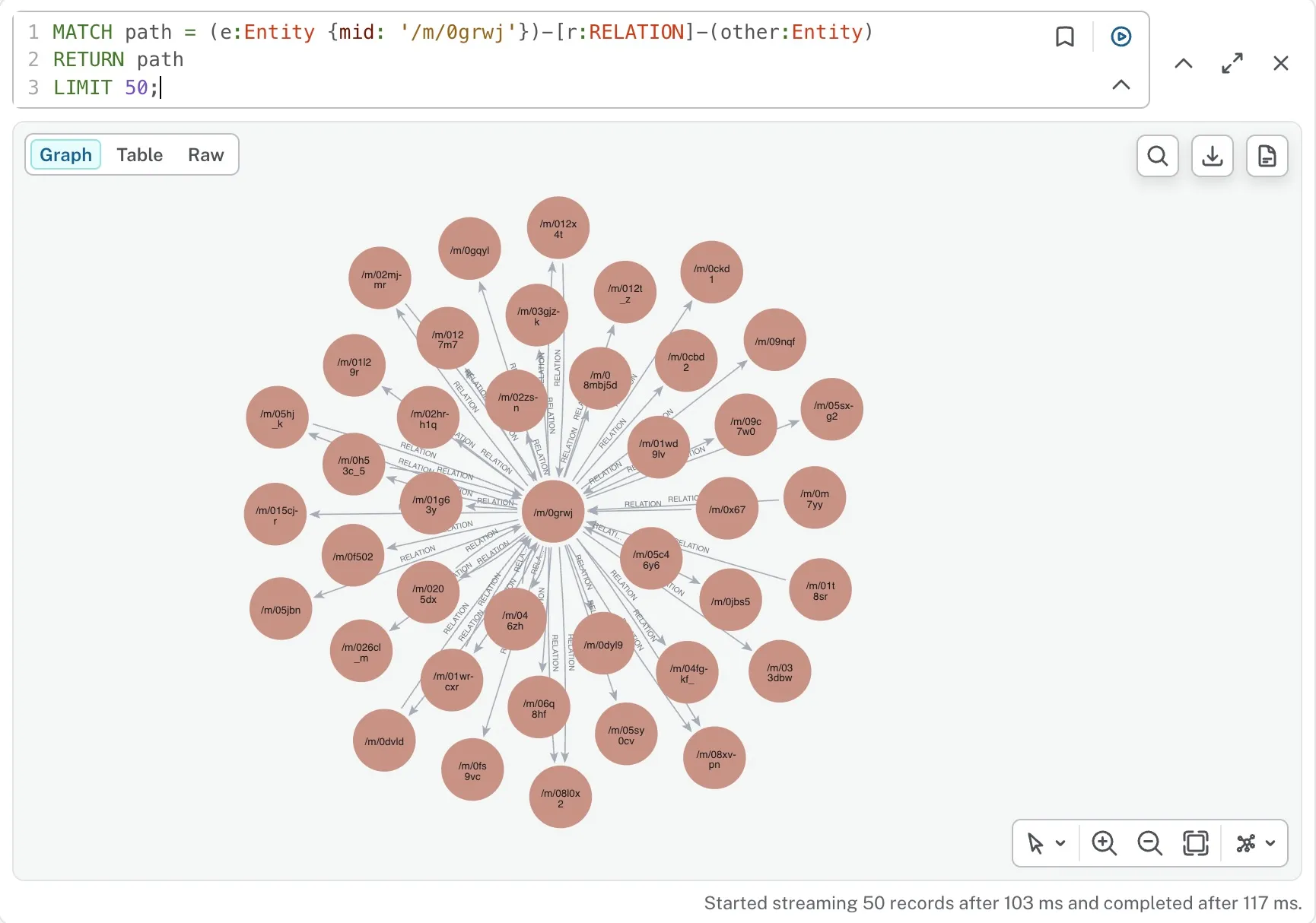
Neo4j Browser displays a connected graph, but the first result is less readable than a typical Neo4j demonstration.
Most nodes still look like this:
/m/0grwj
/m/05sxg2
/m/02...
The graph contains connections, but the nodes do not contain readable names.
Exploring paths
Even without labels, Cypher can reveal structural patterns.
Find paths up to two hops from an entity:
MATCH path = (:Entity {mid: '/m/0grwj'})-[:RELATION]->{1,2}(:Entity)
RETURN path
LIMIT 50;
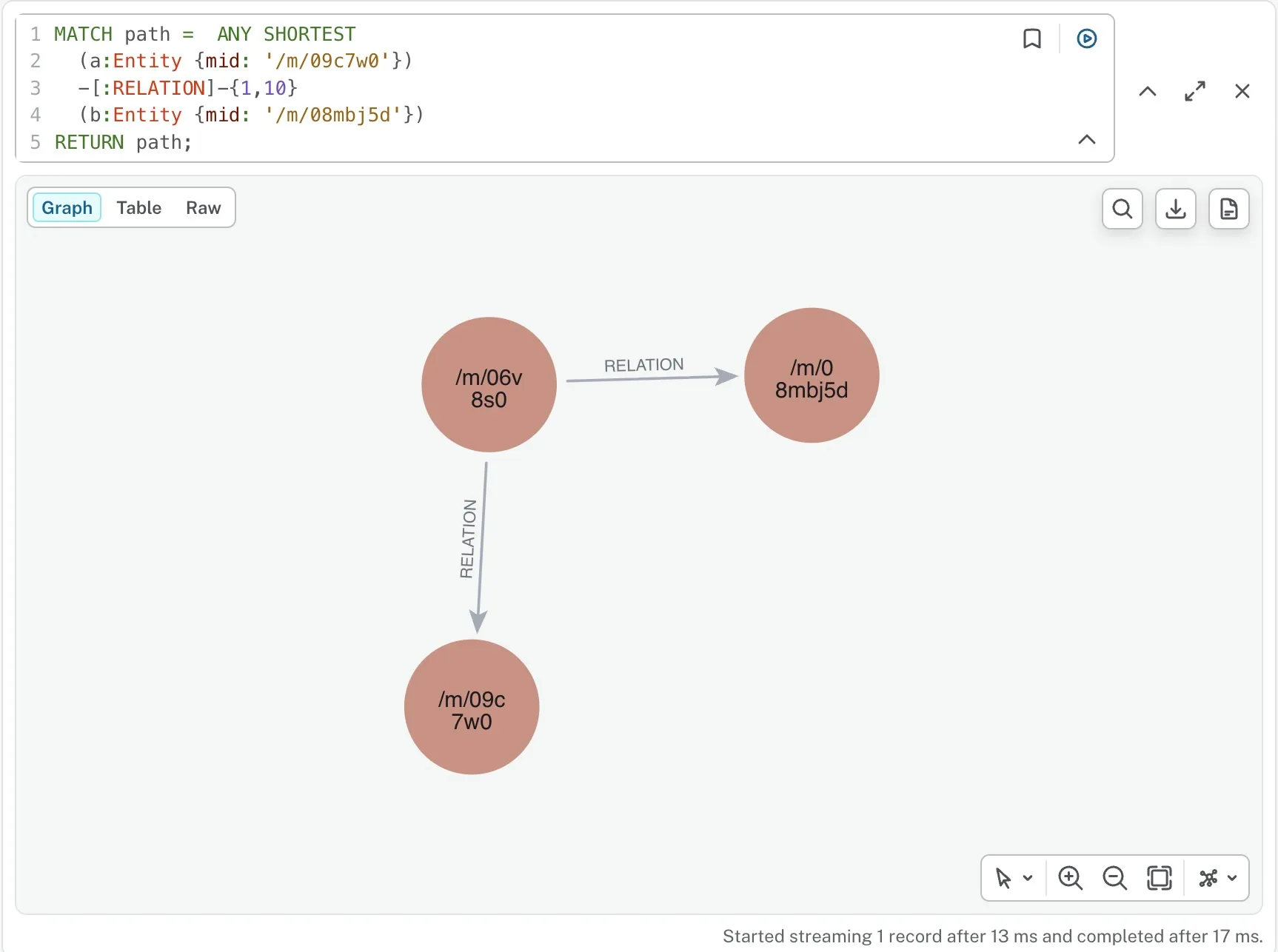
Find a shortest path between two known MIDs:
MATCH path =  ANY SHORTEST
  (a:Entity {mid: '/m/09c7w0'})
  -[:RELATION]-{1,10}
  (b:Entity {mid: '/m/08mbj5d'})
RETURN path;
Find entity pairs connected by more than one relation name:
MATCH (a:Entity)-[r:RELATION]->(b:Entity)
WITH a, b, collect(DISTINCT r.name) AS relations
WHERE size(relations) > 1
RETURN a.mid AS subject,
       b.mid AS object,
       relations
LIMIT 20;
These queries confirm that FB15K-237 is a real multi-relational graph. What it lacks is a human-readable semantic layer.
What the imported graph reveals
At first, I wondered whether the import was incomplete.
There were thousands of nodes and hundreds of thousands of relationships, but almost every node displayed only a MID. The triple files contained no names, descriptions, dates, sources, or images.
Nothing was missing from the import. That is what the benchmark files contain.
This made the purpose of FB15K-237 much clearer.
A knowledge graph completion model can use /m/0grwj as an entity identifier and learn a vector embedding for it. It can learn from topology without knowing the entity’s human-readable name.
A person exploring the graph has different requirements. We want to understand what each node means, where a fact came from, and whether it is current.
Japanese note:
ロード後にMIDしか表示されないのは失敗ではなく、元のベンチマークが主に構造学習を目的としているためです。人が知識を理解するには、名称、型、出典、時間などの追加情報が必要になります。
Relation names contain partial meaning
The relation names are more readable than the entity MIDs.
Examples include:
/people/person/profession
/location/location/contains
/film/film/genre
These path-like names carry some domain and type information.
However, some Freebase relations represent collapsed two-hop paths. Intermediate Compound Value Type nodes from the original Freebase model were removed when the benchmark triples were produced.
That simplification is convenient for link-prediction experiments, but it means that FB15K-237 is not a complete reconstruction of the original Freebase data model.
Adding readable names
The old Freebase API is no longer available, but Google still publishes:
- the final Freebase RDF dump
- deleted triples
- Freebase-to-Wikidata mappings
These resources are available from the Freebase data dumps page.
A practical enrichment process would be:
- collect the MIDs used in FB15K-237
- extract matching labels and mappings from the Freebase dump
- add properties such as
nameandwikidataIdto the Neo4j nodes
This would make the graph easier for people to explore without changing the original benchmark triples.
The complete Freebase dump is very large, so extracting only the MIDs used by FB15K-237 is more practical than importing the entire dump for this purpose.
What the import taught me
Loading FB15K-237 into Neo4j was technically straightforward. The source files were already triples, so the mapping to nodes and relationships was direct.
A simple first model is enough:
- use one
Entitynode label - preserve each MID as a unique node property
- store the original relation name on
RELATION - keep the
train,valid, andtestsplit on each relationship
After the import, Cypher can answer structural questions such as:
- Which relations are most frequent?
- Which entities have the highest degree?
- How are two MIDs connected?
- Which entity pairs have multiple relations?
The more important lesson came from what the graph did not contain.
| Benchmark graph | Human-oriented knowledge graph |
|---|---|
| Entity IDs | Readable labels and descriptions |
| Relation names | Definitions and ontology |
| Topology | Provenance and temporal context |
| Fixed splits | Update and deletion rules |
| Link-prediction targets | Explanation and governance |
FB15K-237 is valuable because it isolates one problem: predicting missing links. It should not be mistaken for a complete model of practical knowledge management.
The MID-only graph is therefore not a disappointing result. It shows exactly what many knowledge graph completion models receive: identifiers, relation names, benchmark splits, and graph structure.
Sometimes the best way to understand a benchmark is to inspect what it leaves out.
References
Related work
Discuss a related technical question.
I support teams that need to evaluate whether a technology fits a real-world problem, review the details that matter, or clarify a practical next step.
日本語・英語どちらでもご相談いただけます。